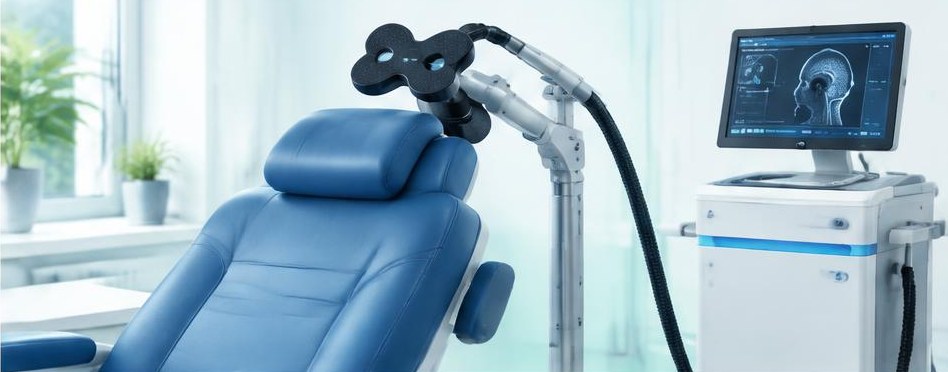
Planning a TMS Course: A Guide to Assessment, Safety, and Review Decisions
Key takeaways
- Confirm the diagnosis, exact protocol, responsibilities, and review plan before starting.
- Report implants, medication changes, sleep disruption, and new symptoms for individualized assessment.
- Short sessions and accelerated courses are different treatment decisions.
- Plan measurement, practical burdens, and post-course care alongside initial treatment.
In this article
Deciding whether to begin TMS involves more than choosing a device or finding an appointment. The decision includes confirming what is being treated, understanding the proposed course, assessing individual safety concerns, and agreeing on how progress will be reviewed. A useful consultation can end with a plan to proceed, seek more information, consider another treatment, or obtain a different level of care. None of those outcomes should be treated as a failed sale.
This guide provides a framework for shared decisions rather than instructions for selecting stimulation settings. TMS is delivered through a clinical service with equipment-specific procedures and trained staff. Research supports particular approaches in particular populations, but the evidence cannot determine an individual's treatment plan without assessment. Good preparation makes the uncertainties easier to discuss and reduces avoidable surprises once a course has begun.
Establish the diagnosis and current priorities
Ask the clinician to explain the working diagnosis and why TMS is being considered now. A depression questionnaire alone does not distinguish every cause of depressive symptoms. A history of mood elevation, psychosis, substance-related problems, or neurological illness may change the assessment and treatment discussion. Share those experiences even if they occurred years earlier or were never given a formal diagnosis.
Bring the practical problems that matter most: inability to eat reliably, difficulty managing basic self-care, prolonged absence from work, or withdrawal from relationships. These help establish goals beyond a rating-scale score. Also describe the pace of deterioration. A routine outpatient course may not address an urgent need for stabilization. Immediate danger, inability to remain safe, or severe deterioration warrants urgent clinical assessment rather than waiting for an elective consultation.
Reconstruct previous treatment fairly
List prior medications, psychotherapy, and other interventions, with approximate dates, duration, benefit, and adverse effects. Note whether treatment stopped because it was ineffective, intolerable, unaffordable, or difficult to access. These are different reasons. An incomplete or interrupted trial should not automatically be counted as a fully tested failure, and a useful past treatment may still inform the next step.
If records are missing, bring what you can rather than delaying indefinitely to create a perfect history. A clinician can identify which details need confirmation. Ask who will continue prescribing and managing psychiatric care during TMS. A stimulation service may not provide every aspect of ongoing treatment, so responsibility for medication reviews, psychotherapy, and between-session concerns should be explicit before the first visit.
Identify the actual course being proposed
Request the protocol name, target, usual visit frequency, anticipated course length, and process for changes. You do not need to become a technician to ask these questions. Their purpose is to distinguish the proposed plan from a broad technology label. Also ask how long appointments take, including preparation and review, rather than relying only on the advertised number of minutes of stimulation.
The THREE-D trial supported noninferiority of its studied intermittent theta-burst protocol compared with 10-Hz rTMS in 414 randomized participants. That evidence can inform a discussion about shorter sessions. It does not establish that any shortened overall course is equivalent. Our theta-burst comparison guide explains why session duration and total treatment schedule must be considered separately.
Examine accelerated offers without assuming equivalence
If a service offers multiple sessions per day, ask for the closest supporting study and how its protocol compares with the service's actual practice. The Stanford Neuromodulation Therapy randomized trial studied an individualized, accelerated high-dose treatment package with 29 treated participants. It cannot validate every schedule described with the word accelerated, nor establish that targeting alone produced the observed benefit.
A compressed course can alter the practical burden rather than simply remove it. Ask about time between sessions, the demands of long treatment days, travel or accommodation, and access to follow-up after returning home. These are planning questions, not reasons to assume intensive treatment is unsuitable. Our accelerated-schedule checklist helps separate logistical advantages from clinical claims that require protocol-specific evidence.
Make safety screening a continuing process
The FDA's 2011 rTMS special-controls guidance discusses risks including seizure, hearing effects, and implanted-device concerns. It is a historical safety source, not a current catalog of every cleared device or indication. The treating service should use applicable device labeling and individualized assessment rather than treating one old guidance document as a complete eligibility rule.
Provide a history of seizures or unexplained loss of consciousness, neurological conditions, head injuries, implanted devices, and relevant operations. Include information about substances and significant recent changes in sleep or medication. Do not decide independently that a detail is irrelevant because treatment is noninvasive. A safe assessment may require additional records, communication with another clinician, or postponement while uncertainty is resolved.
Resolve implant questions before treatment day
Bring the manufacturer, model, location, and available documentation for implanted electronic devices or metal-related surgical hardware. Different devices and locations raise different questions. An MRI compatibility statement does not automatically answer the TMS question, because the exposures and device-specific considerations are not identical. Avoid relying on a friend's experience with an apparently similar implant.
Ask who reviews the information and how the decision is documented. Some cases may need consultation with the device manufacturer or the clinician responsible for the implant. Our implanted-device assessment guide describes useful preparation. The aim is neither to exclude everyone with an implant nor reassure everyone in advance, but to make an individualized decision using the correct technical information.
Coordinate medicines, sleep, and session readiness
Provide a complete list of prescribed medicines, nonprescription products, supplements, alcohol, and other substances. Tell the team when another clinician changes treatment during the course. Do not stop a prescription or alter a dose to improve eligibility without the responsible prescriber's advice. Coordination is more important than trying to keep the treatment record artificially simple.
Ask what changes should prompt a call before arriving, including substantial sleep disruption, illness, or unusual symptoms. The team should explain its assessment process without giving the impression that patients must conceal problems to avoid losing a paid appointment. Our sleep and session-readiness guide offers a practical reporting framework. A postponed session can be an appropriate safety decision rather than a failure to follow treatment.
Ask about comfort and hearing protection
Discuss what stimulation may feel and sound like, how staff assess discomfort, and what to do if symptoms change. Ask how hearing protection is supplied, fitted, and checked. The coil click is not merely background noise to tolerate. Inform staff about hearing concerns and report new symptoms rather than waiting until the end of a course.
Clarify who is present during sessions and how to summon help. Ask what happens if a person becomes unwell, whether staff can assess the problem promptly, and how emergency escalation works. These operational details are more informative than a general statement that treatment is safe. Individual tolerability should be reviewed during care, even when earlier sessions were uneventful and the patient is familiar with the equipment.
Agree on review points before starting
Choose a baseline depression measure and two or three functional goals. Ask when the team will review progress and how missed visits, concurrent treatment changes, and adverse effects will be considered. Measuring symptoms consistently helps identify trends, but a number should not replace a clinical conversation. Function may improve at a different pace, and worsening sleep or unusual mood elevation deserves attention even if energy increases.
Define what would count as meaningful benefit, partial improvement, or insufficient progress. Avoid demanding a universal stopping threshold from an educational guide; that requires clinical judgment and the details of the course. Instead, request a clear reassessment process. A service should explain how decisions are made when improvement is absent or burden becomes unacceptable, rather than guaranteeing that persistence alone will eventually produce remission.
Request a copy of the assessment summary when possible. It can help the usual clinician understand which symptoms are being followed, which concerns remain unresolved, and who will act on changes. Shared documentation is particularly useful when treatment takes place far from home or involves several services with separate appointment systems.
Plan for the end before the first session
Ask what happens after the acute course, whether a review visit is included, and who manages returning symptoms. Initial response and sustained benefit are separate questions. Neither the THREE-D comparison nor the small accelerated trial establishes a single maintenance schedule for everyone. The clinician should distinguish evidence supporting the initial course from the rationale for any proposed continuation or retreatment plan.
Review costs, insurance requirements, travel, cancellation rules, and the implications of changing course. Financial arrangements should not determine whether a concerning symptom is reported or whether a clinical reassessment occurs. Leave with a written outline of the proposed treatment, major uncertainties, safety contacts, review dates, and alternatives. A sound decision is one that remains understandable after the consultation, including the option to pause and seek another opinion.
Medical disclaimer: This article provides general education, not diagnosis, individualized treatment advice, or emergency care. Evidence and regulatory statements refer to the dated sources cited, not an exhaustive review of subsequent changes.
Sources
Written by
TMS News Editorial Team
The TMS News editorial team covers transcranial magnetic stimulation research, treatment access, and patient education, drawing on peer-reviewed studies and leading clinical centers.
 PreviousDepression Trials and TMS Marketing: Comparing Like With Like
 NextHearing Protection During TMS: Why the Coil Click Deserves Attention