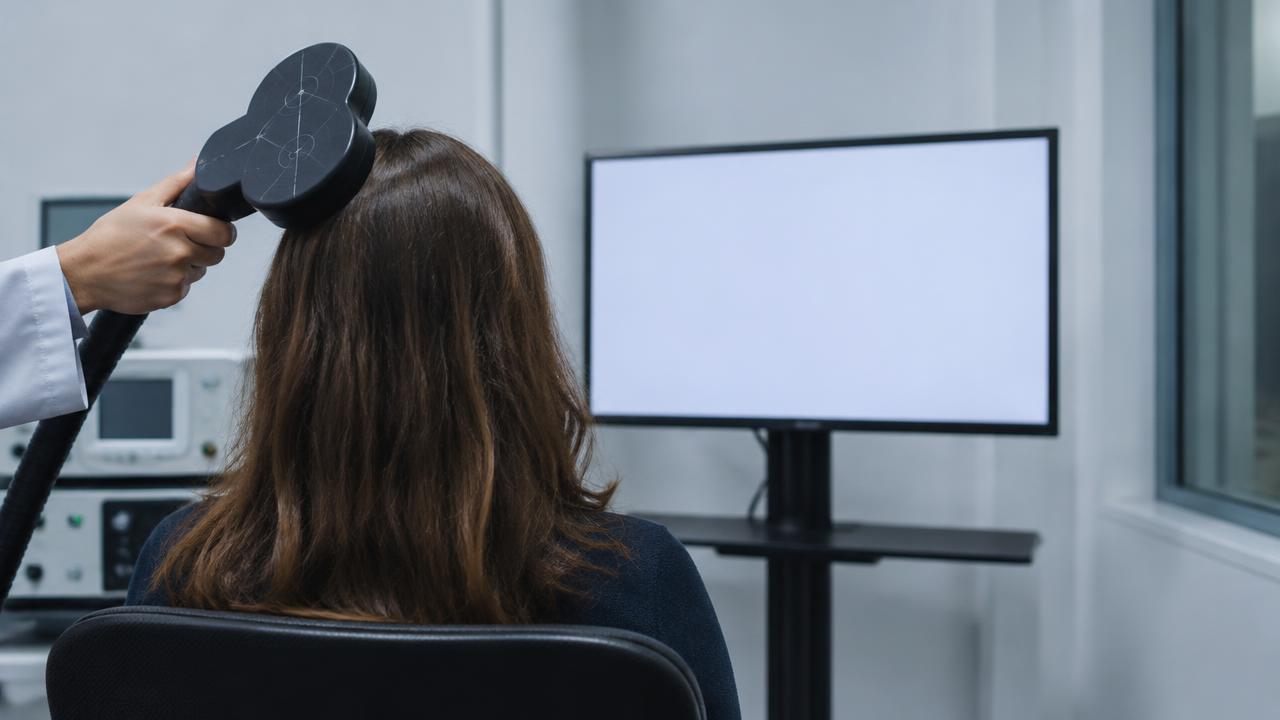
Does Brain State Matter During TMS? A 2025 Review Examines Symptom Provocation
What someone is experiencing during a TMS session may matter alongside where and how magnetic pulses are delivered. A systematic review and meta-analysis published June 4, 2025, in JAMA Psychiatry examined the association between symptom provocation and clinical response in TMS studies for obsessive-compulsive disorder and nicotine dependence.
The question is clinically relevant because the FDA-cleared protocols discussed in the paper for these conditions include activation of a symptomatic state. For OCD, that can involve provoking obsessive-compulsive thoughts; for nicotine dependence, it can involve inducing craving. The review asks how this aspect of treatment relates to outcomes.
What symptom provocation means
Symptom provocation is a structured attempt to bring a relevant symptom into the foreground. It is not simply asking someone whether they feel unwell. In the protocols examined by the review, the aim is to engage a symptom-related state around the time of stimulation.
The underlying hypothesis is that TMS effects may depend partly on the activity of the brain circuitry being stimulated. That does not mean the mechanism is settled or that greater distress automatically produces a better result. It is a testable explanation for why treatment context could influence response.
The scale of the evidence review
The review's study-characteristics materials cover 71 studies: 44 involving OCD and 27 involving nicotine dependence. Its meta-analysis materials describe 63 studies contributing to that quantitative analysis. Those numbers should not be confused with 71 trials directly randomizing symptom provocation itself.
This distinction is essential. A literature review can compare patterns across studies that used different treatment procedures, but those studies may differ in many ways besides provocation. The strength of the causal conclusion depends on how well those other differences can be addressed.
Why the question is different from changing the coil
TMS research often emphasizes hardware, pulse frequency, or anatomical targets. Symptom provocation asks about another layer: the patient's state when stimulation is delivered. Two sessions with similar machine settings may not be identical experiences if the surrounding tasks engage different thoughts, sensations, or urges.
The review therefore brings attention to procedures that may be easy to omit from simplified descriptions of treatment. If a published protocol includes a structured task, the task is part of what was studied. Evidence for the full protocol should not automatically be attributed to the pulses alone.
Association is not the same as a direct test
The paper is explicitly framed around the association between provocation and clinical response. Comparing studies with and without provocation cannot, by itself, establish that adding provocation causes better outcomes. Coil type, treatment target, dose, participant characteristics, and study quality may also differ.
The review includes sensitivity analyses and analyses accounting for TMS protocol, reflecting the need to examine those influences. Even with such methods, a strong next step is a trial that holds the stimulation procedure constant while directly randomizing the provocation component.
What patients should not infer
This research is not an instruction to make yourself as distressed as possible before treatment. It does not support using unsupervised triggers, smoking to generate cravings, or abandoning a clinician's established procedure. Symptom activation needs to be understood within the specific protocol being delivered.
It also should not be generalized automatically to depression or every other proposed use of TMS. The review focused on OCD and nicotine dependence. Whether a particular task improves outcomes in another diagnosis requires its own evidence.
Useful questions for a treatment team
- Does this protocol include a symptom-provocation task?
- What is the purpose of that task?
- How will discomfort or distress be monitored?
- What evidence supports the entire protocol being offered?
Why this remains a notable research direction
The broader implication is that TMS may need to be studied as a carefully specified clinical procedure, not only as a device delivering pulses. Researchers need clear descriptions of what participants do before and during stimulation so findings can be replicated and interpreted accurately.
For readers following TMS developments, this is a useful change of emphasis. More detailed attention to brain state could help explain differences among studies, but it is not a shortcut around controlled trials. The immediate contribution of the 2025 review is to organize a clinically important question and identify why better direct comparisons matter.
Sources
Frequently Asked Questions
- What is symptom provocation in TMS?
- It means deliberately activating a relevant symptom state, such as obsessive-compulsive thoughts or nicotine craving, as part of a supervised treatment protocol.
- Which conditions did the review examine?
- The review examined TMS studies in obsessive-compulsive disorder and nicotine dependence.
- Should patients provoke symptoms before appointments on their own?
- No. Any symptom-provocation procedure should follow the treating clinician's protocol and safety guidance.
Written by
TMS News Editorial Team
The TMS News editorial team covers transcranial magnetic stimulation research, treatment access, and patient education, drawing on peer-reviewed studies and leading clinical centers.
 PreviousMeasuring TMS Progress: Why Response and Remission Are Different
 NextMotor Threshold in TMS: A Calibration Measure, Not a Depression Score